
Tokenized Project Investment
Infrastructure for structuring, representing and managing real-world projects through tokenization, programmable rules and connected off-chain systems.
Tokenized Project Investment is a project-centered infrastructure model that can connect legal and operational structures, digital rights representation, eligibility controls, participation flows, settlement, lifecycle events and reporting. A token or digital record does not automatically determine ownership, rights, liquidity or regulatory approval; outcomes depend on the asset, legal structure and applicable jurisdiction.
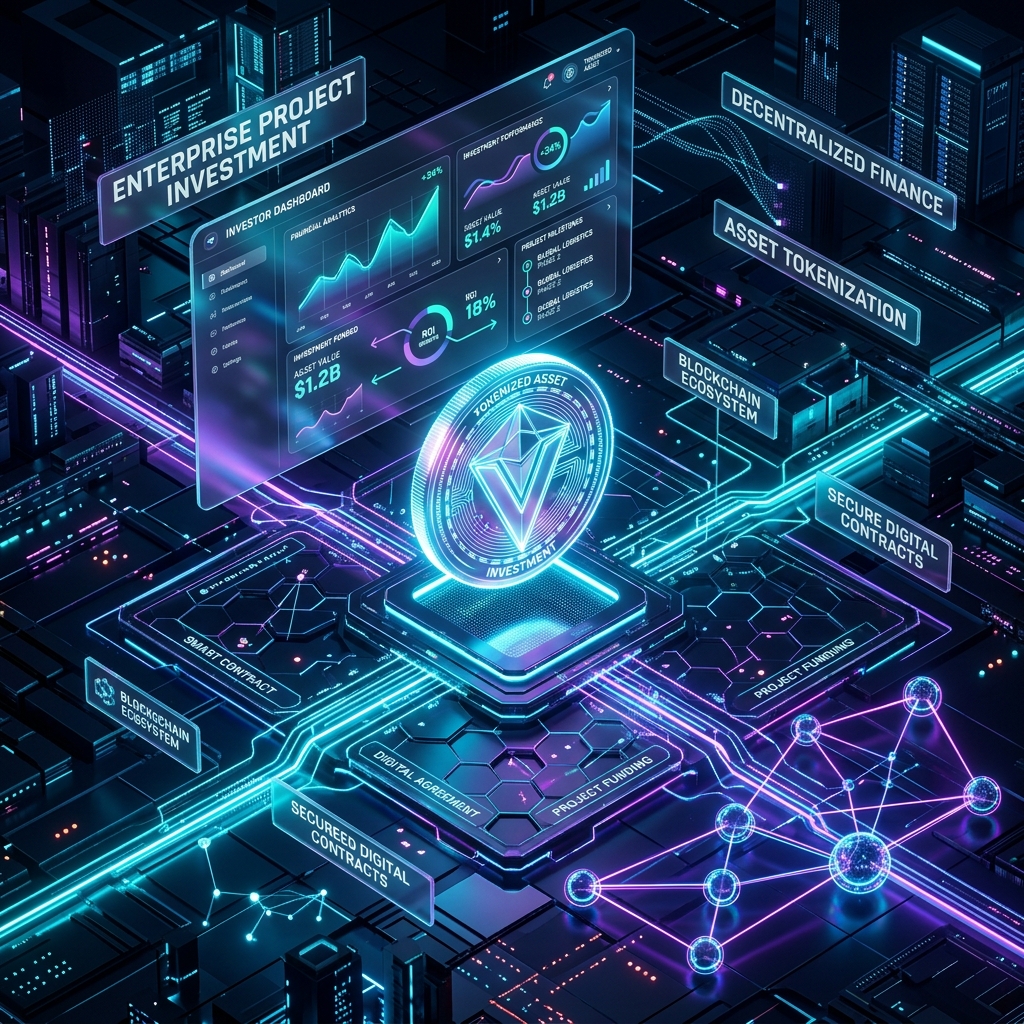
PROJECT-CENTRIC ARCHITECTURE
Tokenized Project Lifecycle
A real-world project is structured first, then connected to digital representation, programmable rules and enterprise systems.
Project
Identify the project, operator, asset, purpose, participants, jurisdiction and evidence sources.
Off-chain
Legal agreements, KYC, banking, custody, accounting and project data systems.
On-chain
Digital representation of rights, automated rules, settlement logic and audit trail.
What Is Tokenized Project Investment?
TokenizedProject Investment describes digital infrastructure for structuring and managing real-world projects. It may combine a business and operating model, digital representation of assets or rights, identity, eligibility, programmable rules, settlement integrations, lifecycle management and reporting.
Technology can coordinate selected records and events, but it does not replace legal documents, custodians, banks, accounting, physical operators or authorities. A token may represent a right, participation, unit or record when the legal and operational structure enables it; it does not automatically imply ownership, an investment offer, liquidity or regulatory approval.
Structuring and operating challenges
Fragmented project models
Legal documents, operational data, financial records, participants and evidence often live in separate systems. A connected architecture can coordinate defined states and responsibilities.
Hard-to-audit lifecycle
Milestones, changes, approvals, payments and events require traceability across teams and providers. Digital records may provide verifiable evidence without replacing real-world validation.
Unclear technology boundary
Digital representation is useful only when the project decides what stays off-chain, which rules can be deterministic and how identity, custody, data and governance are managed.
How It Works
Project
Identify the project, operator, asset, purpose, participants, jurisdiction and evidence sources.
Structuring
Define entity, rights, obligations, contracts, jurisdiction, processes, responsibilities and enforceability mechanisms within the applicable legal structure.
Asset / Rights Model
Determine which asset, right, unit, milestone or flow could be represented and what legal right, if any, is associated with that representation.
Tokenization
Create a digital representation when appropriate and document issuance and custody.
Eligibility
Evaluate identity, KYC/AML, sanctions, jurisdiction and participant eligibility.
Investment / Subscription
Coordinate a possible participation or subscription instruction without presenting an offer.
Settlement
Coordinate payment rail, delivery, custody, ledger and reconciliation when applicable.
Lifecycle
Record states, milestones, changes and events while physical operations remain connected off-chain.
Reporting
Assemble authorized evidence and status through indexers, APIs and enterprise sources.
Events / Distribution
Record or execute defined events where legally and operationally applicable.
System Architecture
Business / Project Model
Legal structure, contracts, jurisdiction, purpose, operations, milestones, assets, rights, obligations and participants.
Asset / Rights Representation
Digital record of rights or units when enabled by the structure.
Settlement / Blockchain
Ledger, events and selected settlement logic connected to payment rails.
Smart Contract Business Logic
Deterministic rules, states, permissions, pauses and authorized actions.
Identity / Compliance
Identity, eligibility, jurisdiction, screening, privacy and evidence.
APIs / Oracles / Connectivity
Connections to ERP, banking, IoT, SCADA, data providers and indexers.
Security / Risk Management
Keys, permissions, resilience, privacy, controls and risk evaluation.
Governance / Enterprise Integration
Administration, disputes, changes, audit, reporting and corporate systems.
Technical Capabilities
- Project, asset, rights, role, milestone and evidence model.
- Identity, KYC/AML, screening, jurisdictional restrictions and allowlists where applicable.
- Programmable rules for eligibility, permitted transfers, states and events.
- Settlement, custody, banking, ERP, accounting, API and oracle integrations.
- Reporting, reconciliation, technical audit trail and change governance.
- Explicit separation of on-chain, off-chain and connected responsibilities.
Project Types
Technical and Operational Benefits
Traceability
May support verifiable records of defined states, milestones and events.
Programmability
May execute deterministic rules for eligible processes and authorized actions.
Automation
May reduce manual work and reconciliation when properly integrated.
Auditability
May provide technical evidence for authorized participants alongside off-chain review.
Interoperability
APIs, indexers, webhooks and oracles may connect records to enterprise systems.
Lifecycle visibility
May improve operational visibility into project states and milestones.
Controlled transfers
Permitted transfers may be restricted according to the applicable structure.
Reconciliation
May help coordinate on-chain, banking, accounting and operational records.
Project framework
Asset Tokenization vs Project Investment
Asset Tokenization
Asset-centric: asks what asset, right, participation, certificate or flow is represented digitally. It does not by itself imply ownership or liquidity.
Tokenized Project Investment
Project-centric: asks how the project, roles, rules, lifecycle, settlement and reporting are structured and managed.
System layers
On-chain, off-chain and connected layer
Thisis a conceptual architecture: blockchain complements traditional systems and does not automatically replace them.
Off-chain
- Legal documents
- Contracts
- ERP and accounting
- Banking and custody
- Due diligence
- Physical operations
- IoT / SCADA
On-chain
- Digital representation
- Deterministic rules
- States and events
- Permitted transfers
- Selected settlement
- Technical audit trail
Connected
- APIs and indexers
- Oracles
- Identity
- Compliance
- External data
- Webhooks
Governance
- Permissions
- Pauses
- Changes
- Disputes
- Administration
- Audit
Legal Structure & Enforceability
Digitalrepresentation does not create legal rights by itself. Rights represented by a token, digital record or other unit must be supported by an appropriate legal structure, contractual documentation, applicable jurisdiction and enforceability mechanisms.
Blockchain can provide traceability and execution of defined rules, but it does not replace legal agreements, authorities, custodians or professional legal review of the applicable framework.
Investment Lifecycle
Origin → Structure
Identify purpose, originator, asset, rights, obligations, participants and jurisdiction within the applicable contractual framework.
Represent → Verify / Qualify
Define what is digitally represented, what legal right, if any, is associated with it, and review identity, documentation, eligibility and restrictions.
Invest / Subscribe → Settle
Coordinate instructions, payment authorization, payment rail, delivery, custody and reconciliation.
Operate → Report
Manage operations, data, milestones, evidence, states and authorized reporting.
Events → Close / Redeem / Exit
Record events and close, redeem, transfer or end according to the applicable structure.
Project framework
Roles and Participants
Originator, issuer and operator
Propose, issue or administer the representation and operate the project; these may be separate entities.
Participant, custodian and administrator
Participate according to defined rights and eligibility; custody funds, assets, keys or records and administer lifecycle or reporting.
Compliance, auditor and data provider
Provide identity, controls, review and operational data. Roles vary by project.
Oracle and platform operator
Connect external data, APIs and workflows while introducing availability, quality and governance dependencies.
Identity, Eligibility & Compliance
Thearchitecture may include KYC, AML/CFT, sanctions screening, jurisdiction restrictions, participant eligibility, transfer restrictions, allowlists, identity providers, privacy, consent, evidence, revocation and recovery. Programmable eligibility and transfer controls are part of a broader organizational, legal and operational compliance framework.
Smart contracts can enforce predefined eligibility and transfer rules within that broader architecture. Technology does not make a project compliant by itself or replace accountable legal and compliance owners.
Settlement and Reconciliation
Theflow may connect an investment or subscription instruction with payment authorization, payment rail, settlement, asset or rights record, custody, reconciliation and reporting. Delivery-versus-payment may be evaluated when the structure allows it.
Blockchain can support settlement models closer to T+0 when the asset, payment rail, participants, custody, liquidity and regulatory framework allow it; it does not guarantee instant settlement in every project or eliminate counterparty risk.
Smart Contracts and Programmable Rules
Smartcontracts are deterministic programs that may execute eligibility checks, transfer restrictions, lifecycle state transitions, allocation rules, event recording, conditional settlement instructions, distributions where legally and operationally applicable, administrative controls, pause mechanisms and authorized actions. They do not create legal rights automatically, replace legal contracts, validate external data automatically, guarantee compliance or eliminate code, key, oracle or operational risks.
Project framework
Risks and Considerations
Project, market and regulatory risk
A project may miss objectives; demand and conditions change; classification and obligations depend on structure and jurisdiction.
Legal and structural risk
Rights, obligations, ownership structures, contractual arrangements and enforceability depend on the applicable legal framework and project structure.
Custody, counterparty and operational risk
Funds, assets, keys, banks, custodians, operators, providers, APIs and processes require controls and accountable owners.
Smart contract, oracle and technology risk
Bugs, permissions, incorrect data, availability, privacy, scalability and interoperability can limit the system.
Governance and liquidity risk
Changes, pauses and disputes need clear rules; digital representation does not automatically create buyers or a market.
Project framework
Related Use Cases
General context for rails, settlement and programmable financial systems.
ExploreTokenized solar energy projects
A vertical energy infrastructure example; this case is not currently registered as an independent catalog route.
Explore the general context
Learn how on-chain financial infrastructure can connect projects, assets, rules and enterprise systems.
Explore On-Chain Financial InfrastructureHow to Evaluate a Tokenized Project
Direct Answer
Tokenized Project Investment is not simply buying tokens. It is a project-centered model connecting legal structure, rights and obligations, digital representation, eligibility, settlement, lifecycle and reporting. Enforceability depends on contractual documentation, jurisdiction and the applicable structure.
Decision Framework
Evaluate this model when a project must coordinate participants, documents, milestones, data, rules and enterprise systems after legal, operational and commercial review.
Key Takeaways
- • Define the project and rights before choosing digital representation.
- • Blockchain complements legal, financial and operational systems.
- • Traceability and automation are conditional capabilities, not financial outcomes.
- • Eligibility, custody, governance and reporting need clear responsibilities.
- • Project, market, legal, regulatory and technology risks remain.
Implementation
- ☐ Define the project and operating model.
- ☐ Identify the asset, right, flow or record to represent.
- ☐ Map roles, documents, jurisdiction, rights, obligations and eligibility.
- ☐ Separate on-chain and off-chain responsibilities.
- ☐ Design settlement, custody, data, lifecycle, reporting and governance.
- ☐ Validate legal, tax and regulatory assumptions before coding.
Common Mistakes
- ✕ Treating a token as automatic ownership or enforceable rights.
- ✕ Assuming blockchain replaces ERP, banking, custody or contracts.
- ✕ Confusing programmable controls with automatic compliance.
- ✕ Assuming digital representation creates a market or liquidity.
- ✕ Ignoring oracle, key, external-data and governance risks.
Frequently Asked Questions
What is tokenized project investment?
How does tokenized project investment work?
What types of projects can use this model?
Is it the same as buying tokens?
Does tokenization mean ownership?
How are the enforceability of represented rights and obligations addressed?
What role do smart contracts play?
How is participant eligibility managed?
What happens off-chain?
Can tokenized projects provide liquidity?
What are the main risks?
Is tokenized project investment regulated?
What infrastructure is required?
Evaluate a Tokenized Project Architecture
Review the project model, rights, participants, integrations, lifecycle and controls before defining a technical implementation.
Evaluate a Tokenized Project Architecture